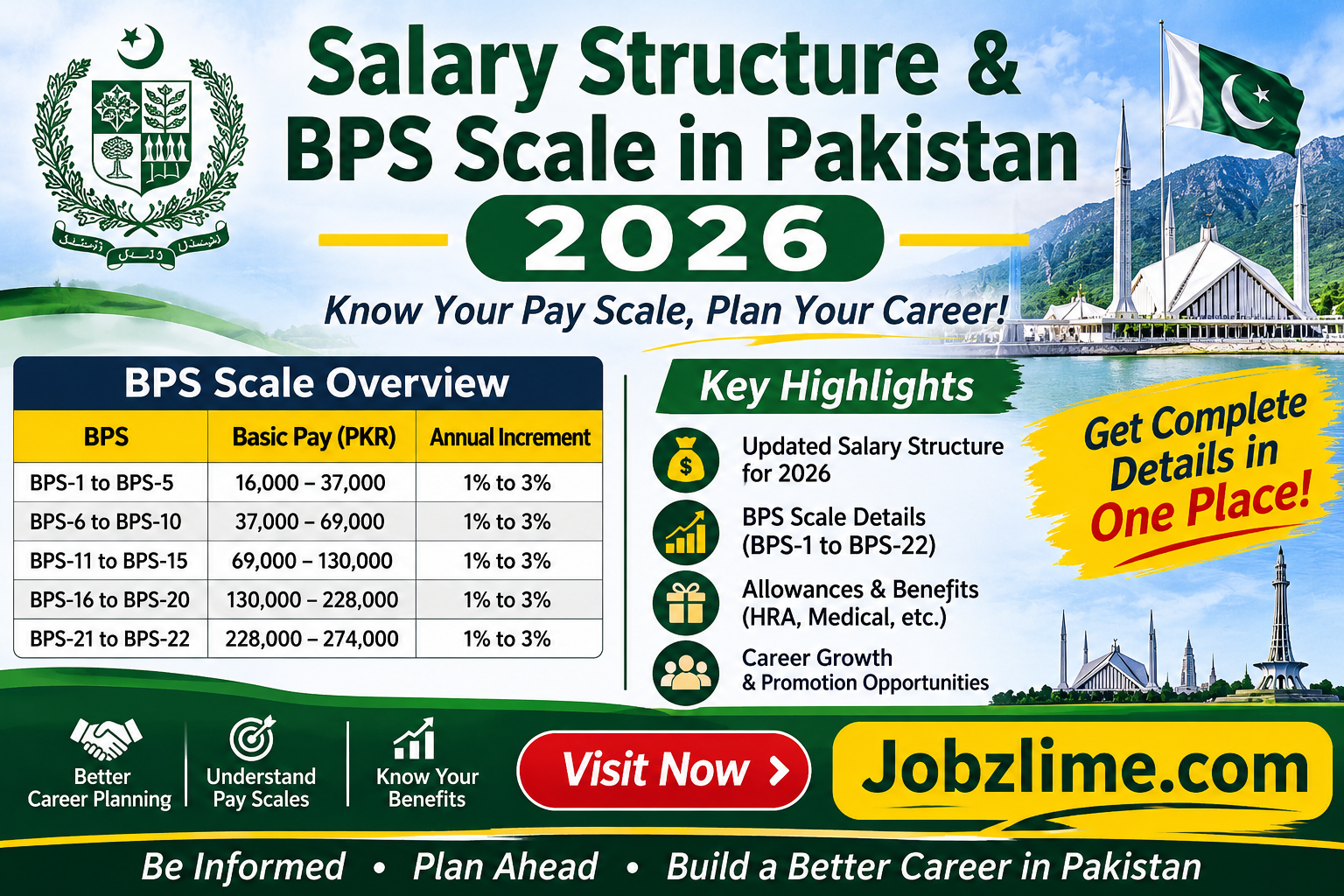
Understanding the salary structure and BPS scale in Pakistan 2026 is essential for anyone planning to join a government department or already working as a public-sector employee. Government jobs in Pakistan offer a structured salary system based on Basic Pay Scale (BPS), which determines an employee’s basic salary, annual increments, professional rank, and other financial benefits. From junior clerks and data entry operators to assistant directors, deputy commissioners, and senior government officers, every position is assigned a particular pay scale according to its responsibilities, qualifications, and service requirements.
The Government of Pakistan periodically reviews its salary policies to provide financial relief to employees and adjust compensation according to economic conditions. In July 2026, the federal government introduced Revised Basic Pay Scales 2026, replacing the previous BPS-2022 structure for eligible federal employees. The revised system also introduced changes to allowances and basic pay calculations.
This comprehensive guide explains Pakistan’s government salary structure, BPS grades, minimum and maximum basic salaries, annual increments, salary types, government posts, and the complete method of calculating monthly earnings. Whether you are preparing for a government job examination or comparing different career opportunities, this article will help you understand how government salaries work in Pakistan.
What Is the Basic Pay Scale System in Pakistan?
The Basic Pay Scale system is the official salary classification framework used by many government departments in Pakistan. It divides government employees into different grades, generally ranging from BPS-1 to BPS-22.
Each grade represents a particular level of responsibility, professional qualification, experience, and administrative authority. Employees working in the same BPS receive basic pay according to the approved salary range, although their total monthly earnings may differ because of allowances and other benefits.
The BPS system provides a standardized structure for government recruitment, promotion, salary increments, and financial administration.
Important characteristics include:
- BPS-1 to BPS-4 generally cover supporting and basic operational positions.
- BPS-5 to BPS-10 include clerical, technical, and junior administrative positions.
- BPS-11 to BPS-16 cover senior clerical, supervisory, and technical roles.
- BPS-17 to BPS-19 generally include officers and professional management positions.
- BPS-20 to BPS-22 cover senior management and high-level government leadership.
- Every pay scale has a minimum salary, annual increment, and maximum salary.
Latest Government Salary Policy and BPS Updates for 2026
The federal government introduced Revised Basic Pay Scales 2026 through a Ministry of Finance notification dated July 21, 2026, with implementation effective from July 1, 2026.
One significant change was the incorporation of the 2022 and 2025 Ad-hoc Relief Allowances into the revised basic pay structure. The government also approved a 7% Ad-hoc Relief Allowance for eligible federal employees under the new arrangement.
Other important developments include:
- Revised minimum and maximum basic salaries across BPS grades.
- Updated annual increment amounts.
- Continuation of annual increments on December 1 under existing conditions.
- A 7% Ad-hoc Relief Allowance on running basic pay for eligible federal employees.
- A 50% increase in conveyance allowance under the separate federal notification.
- Updated salary fixation arrangements for existing employees.
- Continued application of relevant service and allowance rules.
Employees should understand that federal notifications do not automatically establish identical salary packages for every provincial government or autonomous organization.
Complete BPS-2026 Salary Structure from Grade 1 to Grade 22
The revised federal BPS-2026 salary structure provides three important figures for every grade: minimum basic pay, annual increment, and maximum basic pay.
The following table provides the officially notified basic pay figures in Pakistani rupees.
| BPS Grade | Minimum Basic Pay | Annual Increment | Maximum Basic Pay |
|---|---|---|---|
| BPS-1 | 16,280 | 520 | 31,880 |
| BPS-2 | 16,600 | 590 | 34,300 |
| BPS-3 | 17,130 | 700 | 38,130 |
| BPS-4 | 17,650 | 800 | 41,650 |
| BPS-5 | 18,300 | 910 | 45,600 |
| BPS-6 | 18,930 | 1,010 | 49,230 |
| BPS-7 | 19,590 | 1,100 | 52,590 |
| BPS-8 | 20,290 | 1,210 | 56,590 |
| BPS-9 | 20,990 | 1,310 | 60,290 |
| BPS-10 | 21,680 | 1,430 | 64,580 |
| BPS-11 | 22,410 | 1,580 | 69,810 |
| BPS-12 | 23,750 | 1,720 | 75,350 |
| BPS-13 | 25,420 | 1,880 | 81,820 |
| BPS-14 | 27,060 | 2,090 | 89,760 |
| BPS-15 | 28,730 | 2,380 | 100,130 |
| BPS-16 | 33,720 | 2,720 | 115,320 |
| BPS-17 | 54,140 | 4,110 | 136,340 |
| BPS-18 | 68,330 | 5,120 | 170,730 |
| BPS-19 | 105,510 | 5,450 | 214,510 |
| BPS-20 | 123,090 | 8,040 | 235,650 |
| BPS-21 | 136,680 | 8,920 | 261,560 |
| BPS-22 | 146,770 | 10,470 | 293,350 |
These figures represent basic pay rather than complete take-home salaries. Actual monthly earnings depend on allowances, deductions, appointment terms, and applicable government rules.
Different Types of Government Salaries in Pakistan
Government employees may receive different forms of financial compensation depending on their employment status, department, and assigned pay scale.
The main salary categories include:
- Basic Salary: The fixed amount assigned to an employee according to the relevant BPS grade and pay stage.
- Gross Salary: The total earnings before deductions, including basic pay and admissible allowances.
- Net Salary: The amount transferred to the employee’s bank account after applicable deductions.
- Contract Salary: Compensation determined by the conditions of a specific contractual appointment.
- Special Pay: Additional compensation approved for particular responsibilities or positions.
- Personal Pay: An amount payable under applicable rules, including certain cases involving increments beyond the maximum of a pay scale.
- Project-Based Salary: Compensation offered under approved government development projects or special employment arrangements.
Understanding these categories helps job applicants evaluate employment offers more accurately.
Difference Between Basic Pay, Gross Salary and Net Salary
Many candidates misunderstand the difference between basic pay and total monthly earnings. A government employee may have a basic salary of Rs. 54,140 in BPS-17, but the amount received each month can be higher because of admissible allowances.
| Salary Category | Meaning | Calculation |
|---|---|---|
| Basic Pay | Fixed pay according to BPS | Approved pay stage |
| Allowances | Additional financial benefits | According to applicable rules |
| Gross Salary | Total earnings before deductions | Basic pay + allowances |
| Deductions | Amounts deducted from earnings | Tax and other recoveries |
| Net Salary | Final payable amount | Gross salary – deductions |
For example, an employee receiving Rs. 60,000 as basic pay and Rs. 25,000 in total allowances has gross monthly earnings of Rs. 85,000 before deductions.
If total deductions amount to Rs. 5,000, the net salary becomes Rs. 80,000.
This is a simplified illustration rather than an official salary quotation.
Major Allowances Available to Pakistani Government Employees
Allowances play an important role in determining the overall financial benefits of government employment. Different departments offer different allowances according to government policies and employee eligibility.
Common allowances include:
- House Rent Allowance for eligible employees who do not receive government accommodation.
- Conveyance Allowance to help cover transportation expenses.
- Medical Allowance for eligible healthcare-related financial support.
- Ad-hoc Relief Allowance introduced through government salary notifications.
- Executive Allowance for eligible officers and designated positions.
- Special Allowance for particular assignments and responsibilities.
- Qualification Allowance where specifically approved.
- Utility or other departmental allowances under applicable policies.
Not every employee receives all these benefits. Some allowances depend on the employee’s BPS, posting location, department, accommodation status, and relevant government notifications.
Government Posts and Ranks Available Under Different BPS Grades
Different government departments recruit employees under different BPS grades. The designation attached to a particular scale depends on the department’s service rules and approved recruitment structure.
Some commonly found examples are:
- BPS-1 to BPS-4: Naib Qasid, Office Attendant, Chowkidar, Mali, and other support positions.
- BPS-5 to BPS-10: Junior technical staff, drivers, clerical support, and departmental assistants.
- BPS-11 to BPS-14: Junior Clerk, Data Entry Operator, Assistant Sub-Inspector in applicable services, and technical staff.
- BPS-15 to BPS-16: Senior Clerk, Assistant, Stenographer, Sub-Engineer, and other supervisory positions.
- BPS-17: Assistant Director, Lecturer, Section Officer, and entry-level officer positions.
- BPS-18: Deputy Director, senior lecturer, and other experienced professional posts.
- BPS-19: Director, senior administrative officers, and equivalent positions.
- BPS-20: Senior Director, senior departmental management, and equivalent appointments.
- BPS-21: Additional Secretary, senior administrative leadership, and equivalent posts.
- BPS-22: Federal Secretary and other top-level government positions.
These are general examples. Actual grades may differ depending on the department, service cadre, recruitment rules, and organizational structure.
How Annual Salary Increments Work Under BPS-2026
Annual increments are an important part of the government salary structure. They allow eligible employees to increase their basic pay as they continue working in their respective positions.
Under the federal BPS-2026 notification, annual increments continue to be admissible on December 1, subject to existing conditions.
For example:
- A BPS-11 employee receives an annual increment of Rs. 1,580.
- A BPS-16 employee receives an annual increment of Rs. 2,720.
- A BPS-17 employee receives an annual increment of Rs. 4,110.
- A BPS-18 employee receives an annual increment of Rs. 5,120.
- A BPS-22 employee receives an annual increment of Rs. 10,470.
The increment is added to the employee’s basic pay according to applicable rules. It does not automatically mean that every employee receives the same increase in net salary because allowances and deductions may also affect monthly earnings.
Federal Government and Provincial Government Salary Comparison
Pakistan has federal and provincial government employment systems. Although many departments use the Basic Pay Scale framework, salary policies and allowances can vary.
| Feature | Federal Government | Provincial Government |
|---|---|---|
| Main Authority | Federal Government | Respective Provincial Government |
| Salary Notifications | Ministry of Finance | Provincial Finance Departments |
| Pay Structure | Federal BPS policy | Provincial adopted pay policy |
| Allowances | Federal rules | Provincial rules |
| Recruitment | FPSC and departmental bodies | PPSC, SPSC, KPPSC, BPSC and others |
| Posting | Federal departments and territories | Relevant provincial departments |
| Salary Benefits | According to federal eligibility | According to provincial eligibility |
Punjab, Sindh, Khyber Pakhtunkhwa, and Balochistan may issue separate notifications regarding salaries and allowances.
Therefore, applicants should always check the relevant provincial finance department’s latest notifications before calculating their expected earnings.
How to Calculate Monthly Government Salary in Pakistan
Calculating government salary requires understanding basic pay, allowances, and deductions.
The general calculation method is:
Gross Salary = Basic Pay + Admissible Allowances + Other Payable Benefits
Net Salary = Gross Salary – Applicable Deductions
For a practical calculation, follow these steps:
- Identify the employee’s BPS grade.
- Find the current basic pay stage.
- Add the applicable annual increment if already granted.
- Identify eligible house rent and conveyance allowances.
- Add applicable medical and relief allowances.
- Include approved special or departmental allowances.
- Calculate income tax and other deductions.
- Subtract deductions from gross salary to determine net salary.
For accurate results, use the salary slip and relevant department-specific notifications rather than relying only on a general online salary calculator.
Important Factors That Affect Government Employees’ Take-Home Pay
Two employees working in the same BPS grade may receive different monthly salaries. This happens because their allowances, service history, and employment conditions may not be identical.
Several factors affect the final salary:
- Basic pay stage and previous service increments.
- Departmental salary policies.
- Posting city and applicable location-based allowances.
- Availability of government accommodation.
- Eligibility for executive or special allowances.
- Employment on a regular or contractual basis.
- Income tax and other statutory deductions.
- Departmental recoveries and financial contributions.
- Promotion and pay fixation history.
Candidates should evaluate the complete compensation package instead of considering the BPS grade alone.
BPS-2026 Salary Calculation Example for New Employees
A new government employee generally starts at the minimum basic pay of the appointed BPS grade unless applicable rules provide a different pay fixation.
Consider an employee appointed in BPS-16.
The salary calculation starts with the following information:
- BPS Grade: 16
- Minimum Basic Pay: Rs. 33,720
- Annual Increment: Rs. 2,720
- Maximum Basic Pay: Rs. 115,320
- Additional Allowances: According to eligibility
- Deductions: According to applicable rules
The employee’s gross salary is calculated by adding eligible allowances to the basic pay. The final amount is determined after subtracting applicable deductions.
This example explains the calculation method and should not be treated as a guaranteed monthly salary for every BPS-16 appointment.
How Promotions Change BPS Grades and Salary Levels
Promotion is one of the major career development opportunities available to regular government employees. Employees may move from a lower pay scale to a higher grade after fulfilling the relevant service conditions.
Promotion generally depends on:
- Required years of service.
- Educational qualifications.
- Departmental promotion policies.
- Seniority position.
- Performance evaluations.
- Departmental examinations, where applicable.
- Availability of an approved higher-grade position.
- Recommendations of the competent promotion authority.
For example, an employee working in BPS-16 may become eligible for promotion to BPS-17 under the relevant service rules.
However, promotion is not automatic. Different departments have different promotion structures, eligibility requirements, and selection procedures.
Special Salary Benefits for Senior Government Officers
Senior government officers may receive additional financial benefits according to their designations, responsibilities, and approved service policies.
These benefits may include:
- Executive allowances for eligible positions.
- Official vehicles or transport facilities where approved.
- Government accommodation under applicable rules.
- Medical facilities for eligible employees and dependents.
- Official travel and daily allowances.
- Special pay for designated responsibilities.
- Training and professional development opportunities.
- Pension and retirement benefits under applicable service rules.
Such facilities are not guaranteed simply because an employee belongs to BPS-17 or a higher grade. Eligibility depends on the relevant notification and the nature of the appointment.
Understanding BPS-2026 Minimum, Increment and Maximum Pay
The minimum, increment, and maximum figures are the three main components of every BPS grade.
| Salary Component | Explanation | Example: BPS-17 |
|---|---|---|
| Minimum Pay | Starting basic salary | Rs. 54,140 |
| Annual Increment | Approved yearly increase | Rs. 4,110 |
| Maximum Pay | Highest regular stage of the scale | Rs. 136,340 |
| Total Stages | Available pay progression stages | 20 |
An employee gradually moves through the salary stages by receiving eligible annual increments.
The maximum pay represents the upper limit of the regular scale, not the maximum possible gross salary. Personal pay and other amounts may be payable under specific rules.
Documents Required for Government Salary and Pay Fixation
Government employees may need to submit specific documents when joining a department, receiving a promotion, transferring between departments, or updating salary records.
Common documents include:
- Appointment letter.
- Joining report.
- CNIC copy.
- Educational qualification certificates.
- Previous service certificate, where applicable.
- Last pay certificate for transferred employees.
- Promotion or transfer notification.
- Bank account details.
- Relevant pay fixation orders.
- Departmental verification documents.
The accounts office or drawing and disbursing officer may request additional documents according to the employee’s circumstances.
Keeping salary-related documents organized helps prevent payment delays and incorrect pay fixation.
How to Check Your Government Salary Slip in Pakistan
A salary slip provides a detailed breakdown of monthly government earnings and deductions. Employees should regularly review it to ensure their payments are correct.
The usual method includes:
- Contact your department’s accounts or payroll office.
- Access the relevant departmental payroll system if available.
- Check your basic pay and current pay stage.
- Review all allowances separately.
- Verify income tax and other deductions.
- Compare your salary with the applicable pay fixation notification.
- Report incorrect entries to the concerned accounts office.
Federal employees may receive salary information through their departmental payroll arrangements and relevant government accounts systems.
The salary slip is an important financial document for bank applications, personal budgeting, and employment verification.
Career Opportunities and Professional Growth Under BPS Grades
Government employment provides several career development opportunities for individuals from different educational backgrounds.
Candidates can apply for positions according to their qualifications and the recruitment requirements of the relevant department.
Some major career areas include:
- Education: Teachers, lecturers, subject specialists, and education officers.
- Healthcare: Medical officers, nurses, pharmacists, and healthcare administrators.
- Administration: Clerks, assistants, section officers, and administrative officers.
- Engineering: Sub-engineers, engineers, and technical directors.
- Information Technology: Computer operators, IT officers, programmers, and assistant directors.
- Law Enforcement: Constables, inspectors, and senior police officers.
- Finance: Accountants, auditors, finance officers, and senior financial managers.
Professional training, experience, departmental examinations, and further education can improve career prospects.
Best Ways to Prepare for Higher BPS Government Jobs
Candidates interested in BPS-17 and above positions should develop strong academic and professional skills.
A practical preparation strategy includes:
- Complete the educational qualification required for the desired post.
- Study the relevant subject syllabus.
- Improve English grammar and communication skills.
- Develop general knowledge and current affairs awareness.
- Practice analytical reasoning and quantitative questions.
- Study Pakistan’s constitution and administrative structure where relevant.
- Prepare for screening tests and interviews.
- Follow official recruitment announcements.
- Review previous examination papers.
- Maintain updated educational and professional documents.
The Federal Public Service Commission and provincial public service commissions regularly advertise competitive government positions according to their recruitment schedules.
Official Sources to Verify BPS Scales and Government Salary Notifications
Salary policies can change through new government notifications, so candidates and employees should rely on official information rather than outdated salary charts.
Useful government resources include:
- Ministry of Finance Pakistan for federal salary notifications and revised pay scales.
- Establishment Division for civil service rules and administrative policies.
- Federal Public Service Commission for federal recruitment advertisements.
- Punjab Public Service Commission for Punjab government vacancies.
- Sindh Public Service Commission for Sindh recruitment.
- Khyber Pakhtunkhwa Public Service Commission for provincial vacancies.
- Balochistan Public Service Commission for Balochistan recruitment.
- Relevant provincial finance departments for provincial salary and allowance updates.
Always verify the effective date, employee eligibility, and applicable pay-scale scheme before making financial or employment decisions.
Conclusion: Understanding Salary Structure and BPS Scale in Pakistan 2026
The salary structure and BPS scale in Pakistan 2026 provide an organized framework for government employee compensation, recruitment, annual increments, and career progression. The revised federal BPS-2026 system introduced updated minimum and maximum basic pay figures, revised increment amounts, and changes to the treatment of relief allowances effective from July 1, 2026.
Understanding the difference between basic salary, gross salary, net salary, allowances, and deductions is important for every government job applicant. It helps candidates compare employment opportunities and understand their potential financial benefits before accepting an appointment.
Employees should also remember that federal and provincial salary policies may differ. The actual amount received depends on the applicable pay scale, service history, allowances, departmental rules, and deductions.
For the latest information, regularly visit official government websites and follow authentic recruitment announcements. A clear understanding of BPS grades and salary calculations can help Pakistani job seekers make better career decisions and plan their professional future with confidence.