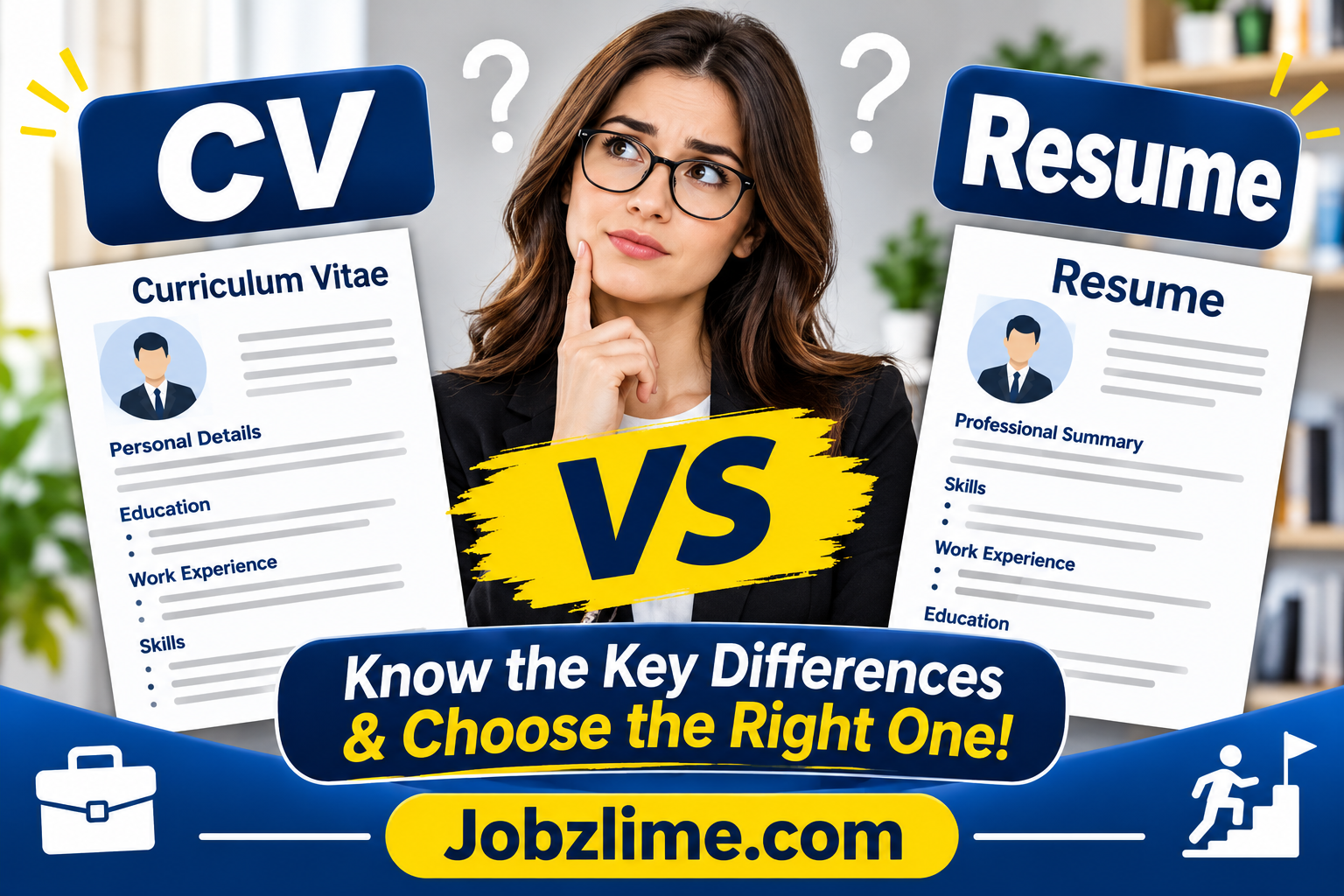
When you begin applying for jobs, one of the first decisions you may face is whether to submit a curriculum vitae (CV) or a resume. The terms are sometimes used interchangeably, but they do not always describe the same document. Choosing the right one matters because employers use application documents to understand your background, assess your suitability and decide whether to invite you for an interview. In some countries, a CV is the standard document for most professional vacancies. In others, employers expect a short, targeted resume for business and industry roles, while reserving the CV for academic or research careers. The distinction can also depend on the employer, profession and instructions in the vacancy announcement.
This guide explains what each document contains, how their formats differ and when to use them. You will learn how to select the right format, organize your experience, present achievements and avoid common application mistakes. Whether you are a student, recent graduate, experienced professional or career changer, understanding the CV vs resume difference will help you prepare a clear and relevant application. The most effective document is not necessarily the longest one; it is the one that gives the employer the information needed to evaluate you for the specific opportunity.
What Is a Curriculum Vitae and What Does It Include?
A curriculum vitae is a detailed record of your education, professional history, qualifications and relevant accomplishments. The phrase means “course of life,” which reflects its broad purpose: to document the development of your academic and professional career. A CV may include degrees, certifications, research, publications, presentations, teaching experience, awards, professional memberships and employment history. Its length depends on the candidate’s experience and the expectations of the field. An early-career applicant may have a concise CV, while a researcher or senior academic may need several pages to document years of work. A strong CV is organized, accurate and easy to scan. It should show a coherent record of your qualifications rather than include every personal detail or unrelated activity.
- Contact information and a professional profile, where appropriate.
- Education, qualifications and relevant professional training.
- Employment, internships, teaching or research experience.
- Publications, projects, presentations and academic contributions when relevant.
- Certifications, awards, memberships, languages and technical skills.
How a Resume Presents Your Professional Value
A resume is a focused summary of your qualifications for a particular job. Rather than documenting every stage of your career, it highlights the experience, skills and achievements most relevant to the vacancy. Many resumes are one or two pages, although length can vary by country, profession and seniority. The purpose is to help a recruiter quickly understand what you can contribute. A resume should therefore be selective: include strong evidence of relevant work, use clear section headings and prioritize recent or significant achievements. Tailoring does not mean changing facts. It means choosing which truthful details deserve the most attention for the role.
- Use a short professional summary that reflects the target position.
- Prioritize relevant employment and measurable accomplishments.
- Include skills that are supported by your experience.
- Remove outdated or unrelated details that do not strengthen the application.
- Keep formatting consistent and make important information easy to find.
Why the CV and Resume Terms Change Across Countries
Geography is one of the main reasons applicants become confused. In the United States and Canada, “resume” is commonly used for most non-academic jobs, while “CV” often refers to a longer academic document. In the United Kingdom, Ireland, much of Europe, Pakistan and several other regions, “CV” is commonly used for the document submitted to a broad range of employers. In some countries, the word CV may therefore describe a document that looks much like an American resume. These are general conventions, not universal rules. International companies, universities and specialist employers may use different terminology. Always read the vacancy instructions and consider the location of the role before choosing a format.
- Check the terminology used in the job advertisement.
- Follow the employer’s stated page limit or document requirements.
- Consider local hiring conventions as well as the organization’s sector.
- When applying internationally, use the format requested by the destination employer.
CV vs Resume: A Quick Overview of Their Main Differences
| Feature | CV | Resume |
|---|---|---|
| Main purpose | Detailed career and academic record | Targeted summary for a specific vacancy |
| Typical length | Can extend across several pages | Often one or two pages |
| Content focus | Broad qualifications and career history | Most relevant skills and achievements |
| Common use | Academic, research and many international applications | Many business and industry applications in North America |
| Customization | Updated for relevance and accuracy | Usually tailored closely to each role |
| Career record | More comprehensive | Selective and concise |
These distinctions are useful starting points, but they should not override an employer’s instructions. In regions where CV is the usual term for all job applications, the expected document may be concise and targeted.
When a CV Is the Better Choice for Your Application
A CV is generally suitable when the employer needs a fuller record of your academic or professional development. Universities, research institutions and organizations recruiting for scholarly roles may want to see publications, research projects, teaching contributions, conference presentations and grants. Certain medical, scientific and specialist positions may also request a detailed CV. In countries where CV is the standard term for job applications, you should use a locally appropriate CV even when the role is not academic. The key is to match the document’s structure and detail to the selection process.
- Academic appointments, fellowships and research opportunities.
- Applications that request publications, research or teaching records.
- Professional roles in countries where CV is the normal application document.
- Positions where a comprehensive record of qualifications is specifically required.
- Opportunities that provide a CV template or detailed content instructions.
Situations Where a Resume Can Make a Stronger Impression
A resume is often the better option when an employer wants a quick, role-specific overview. It is common for private-sector positions in the United States and Canada, including many roles in business, technology, sales, administration and operations. A concise resume helps recruiters compare applicants efficiently by placing relevant experience near the top. It is also useful when you have a varied work history and need to emphasize the experience that best matches a particular vacancy. If the employer uses the term “resume,” follow that request rather than sending a lengthy academic CV.
- Corporate and commercial vacancies that request a resume.
- Applications with a strict one-page or two-page limit.
- Career changes where transferable skills need to be emphasized.
- Roles where recent achievements matter more than a complete academic record.
Choosing the Right Document for Different Career Fields
Industry expectations can be just as important as country conventions. Academic employers usually need evidence of research, teaching and scholarly output. A marketing manager, software developer or customer service professional may be assessed mainly on practical results, tools and job-related experience. Healthcare and engineering applications can vary: some employers request a detailed CV, while others prefer a concise professional resume. Creative industries may ask for a portfolio alongside either document. Before preparing your application, review several comparable job advertisements and identify the information employers repeatedly request.
| Career field | Common document approach | Useful supporting evidence |
|---|---|---|
| University teaching | Academic CV | Teaching, research, publications and qualifications |
| Research and science | Detailed CV | Methods, projects, papers and presentations |
| Business and administration | Resume or local-standard CV | Operations, communication and performance results |
| Information technology | Targeted resume or local-standard CV | Technical stack, projects and measurable outcomes |
| Creative work | Targeted resume plus portfolio | Selected work, tools and client or project results |
| Healthcare | Employer-requested CV or resume | Licensing, clinical experience and relevant training |
How to Structure a Professional CV from Top to Bottom
A well-organized CV allows a reader to understand your background without searching through dense paragraphs. Start with your name and reliable contact details. Add a short profile if it helps explain your professional direction. Place education or experience first according to what is most relevant to the opportunity. Academic applicants may put education, research and publications near the top; experienced professionals may lead with employment history. Use reverse chronological order within sections so that recent information appears first. Include dates consistently and explain any unusual gaps briefly when necessary. Do not add sensitive personal information unless it is legally required or specifically requested by the employer.
- Contact details: professional email, phone number and location at an appropriate level.
- Profile: a brief summary of expertise and career focus.
- Education: qualifications, institutions and completion dates.
- Experience: roles, responsibilities and relevant achievements.
- Additional sections: certifications, publications, projects, awards or languages.
Building a Resume That Recruiters Can Scan Quickly
Resume structure should make the strongest evidence visible early. Place your name and contact information at the top, followed by a concise summary or headline when useful. Add a skills section if the role requires specific tools or capabilities, then present relevant employment in reverse chronological order. Under each position, focus on results rather than listing routine duties. For example, “prepared weekly reports” describes an activity, while “introduced a reporting template that reduced preparation time” explains a contribution. Use numbers only when they are accurate and can be explained in an interview. A resume should be concise without becoming vague.
- Choose section headings that are familiar to recruiters.
- Use short bullet points to describe outcomes and contributions.
- Place the most relevant qualifications and skills where they are easy to notice.
- Keep dates, job titles and formatting consistent throughout the document.
- Remove content that does not support your suitability for the role.
Length, Detail and Formatting: What Employers Usually Expect
There is no single page limit that applies to every CV or resume. A resume for an early-career applicant may fit on one page, while a more experienced candidate may need two. An academic CV can be longer because it records publications, research and teaching. The correct length is the shortest document that communicates the evidence the employer needs. Use readable fonts, adequate spacing and clear headings. Avoid decorative layouts that make the content difficult to scan or interfere with applicant tracking systems. Save the file in the format requested by the employer, commonly PDF or Word, and use a clear filename such as your name and the document type.
- Use a consistent font and comfortable text size.
- Keep margins and spacing balanced.
- Use bold styling sparingly for section labels or job titles if appropriate.
- Do not shrink text excessively just to meet an arbitrary page count.
- Check that the final document displays correctly on different screens.
How Applicant Tracking Systems Read CVs and Resumes
Many employers use applicant tracking systems (ATS) to collect applications and help recruiters search or review candidate information. These systems differ, so no layout can guarantee a successful result. A straightforward document with standard headings, selectable text and relevant terminology is generally a sensible choice. Use keywords naturally when they accurately describe your experience. For example, if a vacancy asks for project coordination, include that phrase where it reflects work you have actually performed. Avoid keyword stuffing, hidden text, complex graphics and tables used to position essential information. Always follow the application portal’s file and formatting instructions.
- Use standard headings such as Experience, Education and Skills.
- Include relevant terms from the vacancy when they truthfully match your background.
- Keep important information in the main document body.
- Use a text-based PDF or Word file when accepted by the employer.
- Review the uploaded file to ensure the text has not shifted or disappeared.
Common Mistakes That Weaken Job Application Documents
Even a qualified applicant can lose an opportunity because of avoidable document problems. Sending the same generic file to every employer may hide the experience most relevant to a vacancy. Spelling errors, inconsistent dates and unclear job titles can also create doubts about attention to detail. Another frequent mistake is describing responsibilities without showing outcomes. Applicants sometimes include personal information, photographs or references when they are not requested. Requirements differ by location, so avoid assuming that a practice used in one country is expected everywhere. A careful final review can improve clarity and professionalism.
- Using a CV or resume format that conflicts with the job advertisement.
- Including inaccurate dates, exaggerated skills or unsupported achievements.
- Writing long paragraphs that are difficult to scan.
- Adding irrelevant personal details or outdated experience.
- Submitting a file with a vague name or incorrect format.
- Forgetting to update contact information before applying.
CV vs Resume for Students and Fresh Graduates
Students and recent graduates may have limited full-time employment history, but they can still create persuasive application documents. Focus on education, internships, volunteer work, university projects, practical assignments, certifications and relevant extracurricular responsibilities. A CV may be expected in many countries, while employers in other markets may request a resume. Select the format according to the vacancy rather than assuming that a lack of experience determines the document type. Explain what you contributed to a project, which tools you used and what you learned. Avoid presenting coursework as professional employment; label academic and practical experience accurately.
- Include relevant coursework only when it supports the target role.
- Describe internships and volunteer work with clear responsibilities and outcomes.
- Show practical projects that demonstrate job-related skills.
- List certifications with the issuing organization and completion date.
- Keep the document focused instead of filling space with unrelated details.
What Experienced Professionals Should Highlight
Experienced candidates should make career progression and professional impact easy to understand. A resume should emphasize the roles, achievements and capabilities that best match the next position. A CV may preserve a broader record of professional development, especially in academic or specialist fields. Avoid giving every job the same amount of space. Recent and relevant positions usually deserve more detail than older roles. If you have managed teams, budgets, clients or complex projects, explain the scope and results accurately. Seniority should be demonstrated through evidence, not simply through a long list of responsibilities.
- Highlight leadership, specialist knowledge and significant achievements.
- Show progression through promotions or expanding responsibilities.
- Quantify results when reliable figures are available.
- Condense older experience that is no longer central to your target role.
- Keep claims factual and prepare to discuss them in an interview.
Adapting Your CV or Resume for International Job Applications
International applications require attention to local expectations. Employers may use different terminology, prefer different document lengths or request information that is not customary elsewhere. A format accepted in one country may appear unfamiliar in another. Research the destination market and follow the employer’s instructions. Use clear language, explain qualifications that may not be recognized internationally and provide translations of degree names where helpful. Do not assume that a photograph, date of birth, marital status or nationality should be included; personal-data expectations and legal requirements vary. If the vacancy specifies a particular format, that instruction should guide your decision.
- Check local conventions for document naming and structure.
- Explain unfamiliar qualifications or professional certifications clearly.
- Use consistent spelling and language appropriate to the destination market.
- Follow instructions about photographs, personal details and references.
- Proofread the document for clarity if English is not your first language.
Practical Checklist Before Sending Your Application
Before submitting either document, compare it with the vacancy announcement. Confirm that the file answers the employer’s requirements and that every statement is accurate. Check contact details, dates, spelling, links and file format. Read the document from the recruiter’s perspective: can someone understand your professional direction and relevant strengths in a short review? Ask a trusted person to proofread it if possible. Keep a master version of your career information and create a tailored copy for each application. This approach saves time while reducing the risk of sending an outdated or incorrectly targeted document.
- Have you used the document type requested by the employer?
- Does the opening section communicate your suitability?
- Are the most relevant skills and achievements easy to locate?
- Are dates, titles, contact details and qualifications correct?
- Does the file open properly and use the requested format?
- Have you removed comments, tracked changes and accidental editing marks?
CV vs Resume: Side-by-Side Decision Guide
| Your situation | Likely best option | What to prioritize |
|---|---|---|
| You are applying for a university research post | Academic CV | Research, publications, teaching and academic qualifications |
| You are applying for a corporate role in the United States | Resume, unless instructed otherwise | Relevant experience, skills and results |
| You are applying for a job in Pakistan | Usually a professional CV | Education, experience and role-related skills |
| You are applying to an international employer | Follow the vacancy instructions | Local conventions and requested information |
| You are changing careers | Usually a targeted resume or local-standard CV | Transferable skills, projects and relevant outcomes |
| The advertisement explicitly names one document | Use the requested document | Required structure, length and file format |
This guide is a decision aid rather than a rigid rulebook. When instructions are unclear, a concise, well-organized document that reflects local hiring practice is usually a practical starting point. You can also contact the employer’s recruitment team for clarification.
Final Thoughts: Choose the Document That Fits the Opportunity
The difference between a CV and a resume comes down to purpose, detail and regional convention. A CV often provides a broader record of academic and professional development, while a resume usually presents a focused summary tailored to a specific job. However, the terminology changes across countries and employers, so the vacancy announcement should always be your first reference. Review the role, identify the evidence the employer needs and select a structure that makes that evidence easy to understand. Keep your information accurate, use clear formatting and tailor the content without exaggerating your experience. A thoughtful application document cannot guarantee an interview, but it can help recruiters recognize your qualifications and understand the value you could bring to their organization. Build a reliable master document, update it as your career develops and prepare a relevant version for every opportunity. When you choose the right format and communicate your strengths clearly, you give your job search a more professional and confident foundation.