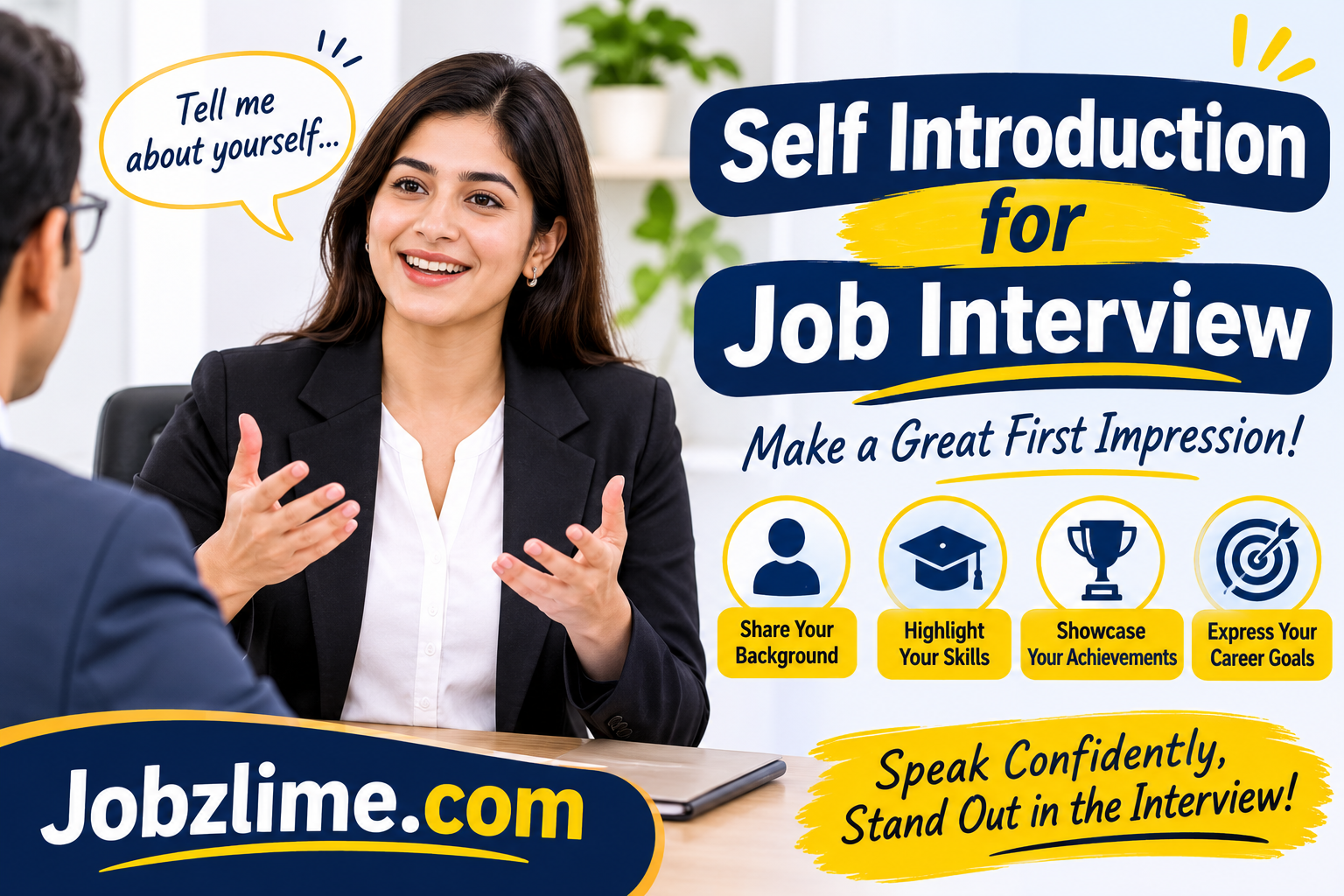
A self introduction for a job interview is more than a short description of your name, education, and experience. It is your opportunity to create a clear first impression, explain why your background matches the vacancy, and help the interviewer understand the value you can bring to the organization. In many interviews, candidates are invited to begin with “Tell me about yourself.” Although the question sounds simple, an unplanned answer can become too long, confusing, or unrelated to the position. A well-prepared introduction, on the other hand, gives the conversation a confident direction. It should briefly connect your professional background, strongest relevant skills, one or two achievements, and interest in the role.
Fresh graduates can focus on education, projects, internships, and transferable abilities, while experienced applicants can highlight measurable results and career development. The best introduction is natural rather than memorized word for word. Before the interview, study the job description, identify the employer’s needs, and practise a concise response aloud. This guide explains practical introduction steps, preparation methods, examples, interview rules, and common mistakes so you can present yourself professionally and make your opening answer meaningful.
What Employers Want to Hear in Your Opening Statement
- A brief professional identity that relates to the position.
- Relevant education, training, or work experience.
- Two or three skills that match the advertised responsibilities.
- A specific achievement, project, or example that supports your claims.
- A genuine reason for applying to the organization or role.
- A confident, positive tone without exaggeration or unnecessary personal details.
Build Your Introduction Around a Simple Career Story
A strong answer follows a logical sequence instead of jumping between unrelated facts. Begin with your current professional position or educational status. Then explain the experience or learning that prepared you for this opportunity. Finish by connecting your strengths to the employer’s requirements. This structure helps the interviewer follow your story and gives them useful topics for follow-up questions. Keep the focus on your professional journey rather than narrating your entire life history.
Choose the Right Details Before You Start Speaking
- Your current role, recent qualification, or career area.
- The most relevant employment, internship, volunteer, or academic experience.
- Skills that you can demonstrate with real examples.
- A result that shows responsibility, improvement, teamwork, or problem-solving.
- Your career direction and why this vacancy is a sensible next step.
Follow a Clear Introduction Format for Better Results
| Introduction section | What to include | Suggested time |
|---|---|---|
| Professional opening | Name and current professional or academic status | 10–15 seconds |
| Background | Relevant education and experience | 20–25 seconds |
| Strengths | Role-related skills and a supporting example | 20–25 seconds |
| Career connection | Why the position interests you | 10–15 seconds |
These timings are flexible. A concise introduction of around one minute is often enough for an initial response. If the interviewer requests more detail, expand naturally.
Prepare a Personal Pitch That Sounds Natural
- Write a first draft using everyday professional language.
- Remove details that do not support your suitability for the vacancy.
- Use active verbs such as managed, assisted, developed, organized, analyzed, or improved.
- Include one genuine example instead of making broad claims.
- Read the answer aloud and replace phrases that feel difficult to say.
- Practise the key points rather than memorizing every sentence.
Fresh Graduate and Experienced Candidate Introductions Compared
| Area | Fresh graduate | Experienced candidate |
|---|---|---|
| Main focus | Education, projects, internships, and potential | Professional experience and demonstrated results |
| Evidence | Coursework, presentations, practical assignments, volunteering | Targets achieved, processes improved, clients supported, teams guided |
| Skills | Technical foundations and transferable abilities | Specialist knowledge, leadership, and job-specific expertise |
| Career goal | Learning, contribution, and professional development | Greater responsibility, specialization, or a relevant next challenge |
How to Introduce Yourself as a Fresh Graduate
If you have limited work experience, do not apologize for being new to the workplace. Explain what you studied, which subjects or projects relate to the vacancy, and what you learned from practical activities. You can mention an internship, final-year project, student society, volunteer role, or part-time responsibility. Select examples that demonstrate reliability, communication, teamwork, initiative, or technical ability. Employers understand that graduates may not have a long employment history; they want to see preparation, curiosity, and the ability to learn.
Present Your Work Experience With Relevant Achievements
| Weak statement | Stronger approach |
|---|---|
| I worked in customer service. | I supported customers, handled routine enquiries, and helped resolve service issues. |
| I know computer skills. | I use spreadsheets and office software to organize records and prepare reports. |
| I am a good team member. | I coordinated tasks with colleagues to complete shared work on schedule. |
| I have leadership skills. | I guided a small team through daily priorities and followed up on assigned tasks. |
Use only statements that accurately describe your experience. If you have measurable results, include them, but never invent figures or claim responsibility for another person’s work.
Research the Employer Before the Interview Day
- Read the organization’s official website and understand its main services or products.
- Review the job advertisement and note its essential responsibilities.
- Learn about the department, customers, or industry where the role operates.
- Identify two skills or experiences that connect your background to the employer’s needs.
- Prepare a thoughtful reason for wanting to join the organization.
- Check the interview location, online meeting link, reporting time, and contact details.
Match Your Skills With the Job Description
Interview preparation becomes more effective when you treat the vacancy as a list of employer needs. Highlight repeated requirements such as communication, data handling, customer support, sales, software knowledge, teaching, or project coordination. For each important requirement, prepare a short example that proves your ability. You do not need to mention every skill in your opening answer. Choose the strongest two or three, then keep other examples ready for later questions. This approach makes your self introduction relevant rather than generic.
Use This Checklist to Plan Your Interview Introduction
| Preparation task | Completed when |
|---|---|
| Read the vacancy carefully | You can explain the main duties in your own words |
| Select relevant background | Your education and experience connect to the role |
| Choose supporting examples | You can explain what you did and what happened |
| Prepare your opening answer | It is clear, concise, and easy to speak |
| Practise delivery | You can speak without rushing or relying on a script |
| Confirm interview arrangements | You know the time, place, format, and required documents |
Sample Self Introduction for a Fresh Graduate
“Good morning, and thank you for giving me this opportunity. My name is [Your Name], and I recently completed my degree in [Subject] from [Institute]. During my studies, I developed an interest in [Relevant Area] and worked on projects that strengthened my skills in [Skill One] and [Skill Two]. I also gained experience in teamwork and meeting deadlines through academic activities. I am interested in this position because it matches my learning and career goals, and I would welcome the opportunity to contribute while developing my professional abilities.”
Replace the bracketed details with accurate information. Add a specific project or internship if it is relevant to the job.
Sample Self Introduction for an Experienced Professional
“Hello, my name is [Your Name]. I have [Number] years of experience in [Professional Field], with a focus on [Specialization]. In my recent role at [Organization], I was responsible for [Relevant Responsibility] and developed strong skills in [Skill One] and [Skill Two]. One achievement I am proud of is [Brief, Accurate Achievement]. I am now looking for an opportunity where I can use this experience to support the team’s objectives and continue growing in [Relevant Area].”
Keep the example truthful and adapt the level of detail to the seniority of the vacancy.
Professional Body Language That Supports Your Words
- Sit upright with a relaxed posture and avoid appearing stiff.
- Make natural eye contact without staring continuously.
- Keep your hands relaxed and use modest gestures when they help explain a point.
- Speak at a steady pace and pronounce words clearly.
- Show that you are listening by avoiding interruptions and responding to the actual question.
- Offer a polite greeting and maintain a professional expression.
Interview Rules That Help You Make a Positive Impression
- Arrive early enough to manage security, parking, or connection issues.
- Wear clean, suitable clothing that fits the organization’s professional environment.
- Keep your phone silent and avoid checking it during the conversation.
- Answer honestly, especially about qualifications, dates, and technical abilities.
- Do not criticize former employers, teachers, colleagues, or interviewers.
- Ask for clarification politely if a question is unclear.
- Thank the interview panel before leaving or ending the call.
Common Self Introduction Mistakes to Avoid
| Common mistake | Why it weakens the answer | Better practice |
|---|---|---|
| Speaking for too long | Important points become difficult to identify | Keep the opening focused and let the interviewer ask for detail |
| Repeating the CV word for word | The answer adds little context | Explain the most relevant parts of your background |
| Using memorized language | The delivery may sound unnatural | Remember key points and speak conversationally |
| Making unsupported claims | Follow-up questions may expose exaggeration | Support strengths with real examples |
| Sharing unrelated personal details | The answer moves away from the vacancy | Keep the focus on professional suitability |
Adapt Your Answer for Online and In-Person Interviews
- For an online interview, test your microphone, camera, internet connection, and meeting link in advance.
- Position the camera near eye level and choose a quiet, well-lit place.
- For an in-person interview, confirm the address, transport plan, and visitor instructions.
- Carry requested documents in an organized folder, including extra CV copies when appropriate.
- In either format, look toward the interviewer, listen carefully, and avoid reading your introduction from a screen.
Prepare for Follow-Up Questions After Your Introduction
Your opening answer often leads to questions about your skills, career choices, achievements, or employment gaps. Prepare to explain every qualification and experience you mention. If you refer to a project, be ready to describe its purpose, your personal contribution, the challenge, and the outcome. If you mention a strength, give an example. If you discuss a career goal, explain how the vacancy relates to it. Preparation should make you more flexible, not force you to deliver a fixed speech regardless of the conversation.
Practise Your Introduction With a Simple Improvement Routine
- Draft a one-minute introduction using the role’s most relevant requirements.
- Read it aloud and remove repeated or unnecessary information.
- Record yourself once and listen for unclear wording, speed, and filler words.
- Practise again using only short notes rather than reading the full script.
- Ask a trusted person to listen and identify any confusing sections.
- Make a final adjustment and get enough rest before the interview.
Conclusion: Make Your First Impression Clear and Memorable
A successful self introduction for a job interview is focused, honest, and connected to the position. It gives the interviewer a quick understanding of your background, relevant abilities, and reasons for applying. Start with a clear professional summary, select a few strong examples, and explain how your experience or education can support the organization. Research the employer, practise your delivery, and follow basic interview rules such as punctuality, respectful communication, and truthful answers. Fresh graduates should highlight learning, projects, and transferable skills, while experienced professionals should emphasize relevant responsibilities and results. Avoid lengthy personal stories, unsupported claims, and memorized speeches. Instead, prepare key points and speak naturally. A thoughtful introduction cannot guarantee a job offer, but it can help you begin the interview with confidence and create a strong foundation for the rest of the discussion.